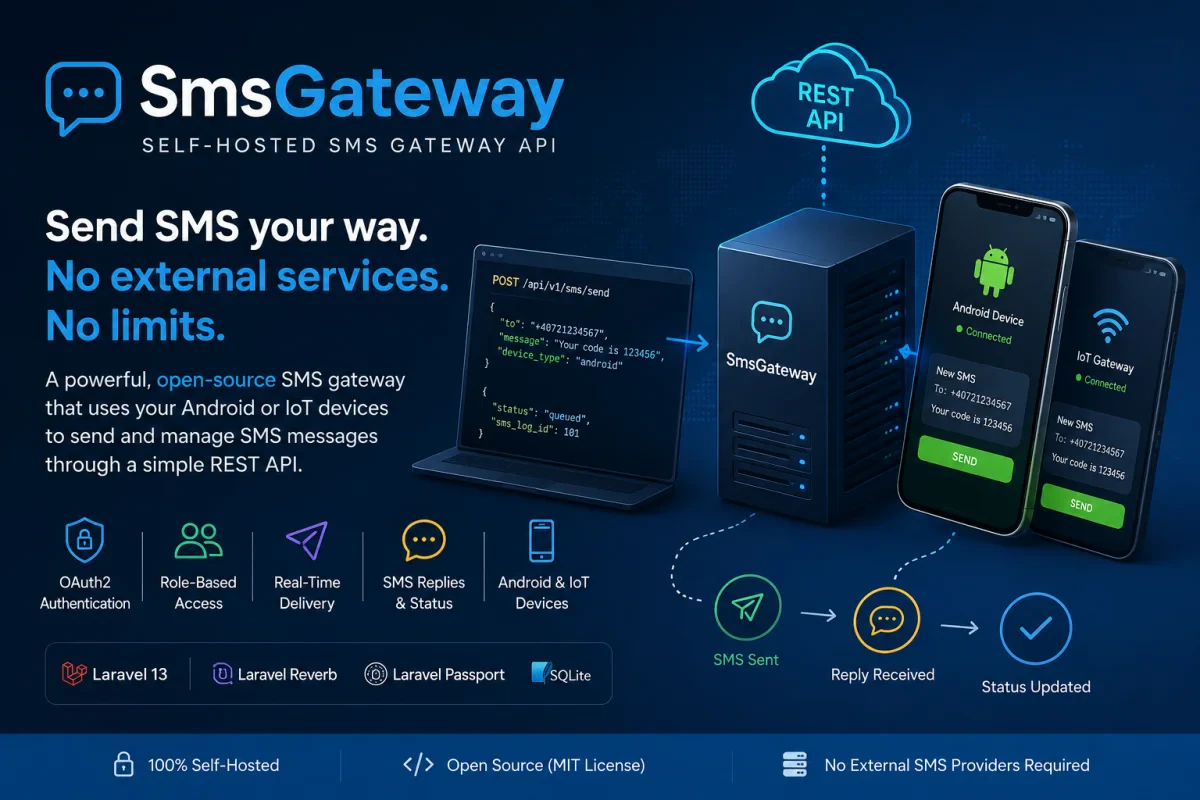
Discover Larave lSms Gateway, a free and open-source self-hosted SMS gateway that lets applications send and manage SMS messages through a REST API using Android phones or IoT gateways.
Need an SMS Gateway Without an External SMS Provider?
Sending SMS messages from a web or mobile application usually means integrating a third-party SMS provider. For many projects this is the easiest approach, but some applications require more control over their infrastructure and the devices responsible for sending messages.
This is where Laravel Sms Gateway comes in.
SmsGateway is a free and open-source self-hosted SMS gateway that allows applications to send and manage SMS messages through a REST API while using your own Android phones or IoT gateways for SMS delivery.
What is Laravel Sms Gateway?
SmsGateway is a software-based SMS Gateway API designed for developers, small and medium-sized businesses, and hobbyists who want to send SMS messages programmatically without relying on external SMS services.
The platform provides an API for:
• sending SMS messages;
• checking delivery status;
• viewing SMS history;
• retrieving SMS replies;
• retrying failed messages;
• registering and managing connected devices.
Instead of sending the SMS through an external cloud SMS provider, SmsGateway sends the request to a compatible device such as an Android phone or IoT gateway. The device then sends the actual SMS through its mobile network connection.
Why Use a Self-Hosted SMS Gateway?
Third-party SMS providers are convenient, but they are not always the best fit for every project.
A self-hosted SMS gateway gives you greater control over the application, infrastructure, API and devices involved in SMS delivery.
SmsGateway can be useful when:
• you already have an Android phone with a SIM card;
• you have a cellular IoT gateway;
• you want to integrate SMS directly into your own application;
• you don't want your application to depend on an external SMS API;
• you want to host the gateway on your own infrastructure.
However, self-hosted does not mean that mobile network costs disappear. You still need a compatible device and SIM card, and your mobile operator may charge for outgoing SMS messages.
How Does Laravel SmsGateway Work?
The architecture connects your application, the SmsGateway server and the device responsible for sending the SMS.
The basic flow is:
Application → REST API → Queue → WebSocket → Android / IoT Device → SMS → Status API
When an application requests an SMS, SmsGateway creates a message record and places the request into a queue.
The queue worker processes the request and broadcasts it to the appropriate device using Laravel Reverb and WebSockets.
The device sends the SMS through the mobile network and reports the result back to the gateway.
If the device does not respond, the system can retry the operation using progressive backoff.
Android and IoT Device Support
SmsGateway is designed to support different types of SMS-capable devices.
The current implementation supports Android and IoT devices, with device-specific WebSocket channels used to route SMS requests.
An Android client is also available to communicate with the gateway and handle SMS requests from the server.
This architecture makes it possible to use an Android phone as an SMS gateway for a web application or use a cellular IoT device for automated SMS communication.
REST API for Application Integration
SmsGateway is built around a REST API, making it possible to integrate SMS functionality into existing applications.
The API includes endpoints for authentication, SMS delivery, delivery status, conversations, retries and device management.
This makes the gateway suitable for integration with:
• Laravel applications;
• PHP applications;
• mobile applications;
• IoT systems;
• internal business applications;
• booking and reservation systems;
• notification platforms;
• OTP and verification systems.
Authentication and Access Control
Security is an important part of the project.
SmsGateway uses OAuth2 authentication through Laravel Passport and provides role-based access control.
The available roles include:
• Admin – manages users and approvals;
• Client – can use the SMS API;
• AppClient – used for application/device clients.
New users can remain pending until an administrator approves them, providing an additional layer of access control.
Technology Stack
SmsGateway is built using modern Laravel ecosystem technologies:
• PHP 8.4
• Laravel 13
• SQLite
• Laravel Passport
• Laravel Reverb
• Spatie Laravel Permission
• Dedoc Scramble for OpenAPI documentation.
The default configuration is also relatively lightweight. Sessions, queues and cache can run using a single SQLite database file, meaning Redis is not required for the basic installation.
Laravel Sms Gateway Use Cases
There are many scenarios where a self-hosted SMS API can be useful.
OTP and Verification Codes
Applications can use the gateway to send one-time passwords and other verification codes to users.
Booking Confirmations
Reservation and booking platforms can send automatic confirmations and notifications and potentially receive SMS replies.
Notifications and Reminders
The API can be integrated into applications that need automated reminders, alerts or event notifications.
IoT Communication
IoT applications can use the gateway to add cellular SMS communication to their automation workflows.
The original project documentation specifically identifies OTP codes, reservation confirmations and reminders as potential use cases.
Free and Open Source
SmsGateway is released under the MIT License and is available as free open-source software.
Because it is self-hosted, you can install the software on your own infrastructure rather than depending on a hosted SaaS platform.
Is SmsGateway a SaaS?
No.
SmsGateway is better categorized as a free open-source self-hosted digital solution rather than SaaS.
With SaaS, the software is normally hosted and operated by the provider. With SmsGateway, you install and manage the software yourself and provide your own SMS-capable devices.
This makes it particularly interesting for developers and organizations that want more control over their SMS infrastructure.
Conclusion
SmsGateway provides a flexible way to add SMS capabilities to your applications without directly integrating a third-party SMS provider.
Whether you're a developer looking for a self-hosted SMS API, a business that wants to use an Android phone as an SMS gateway, or an IoT developer working with cellular devices, SmsGateway provides an open-source foundation for building your own SMS infrastructure.
SmsGateway is available for free and released as open-source software. Source code can be found on GitHub Azelya
Article Info
Related Articles

PrestaShop vs. custom Laravel + Vue.js: ce alegi pentru un IMM în 2026?
Sep 08, 2026
Digital Solutions

Cât costă un site de prezentare în România în2026?
Sep 02, 2026
Digital Solutions

Website Maintenance and Management: Services, Costs, and Why Your Business Needs Ongoing Support
Jul 09, 2026
Digital Solutions